

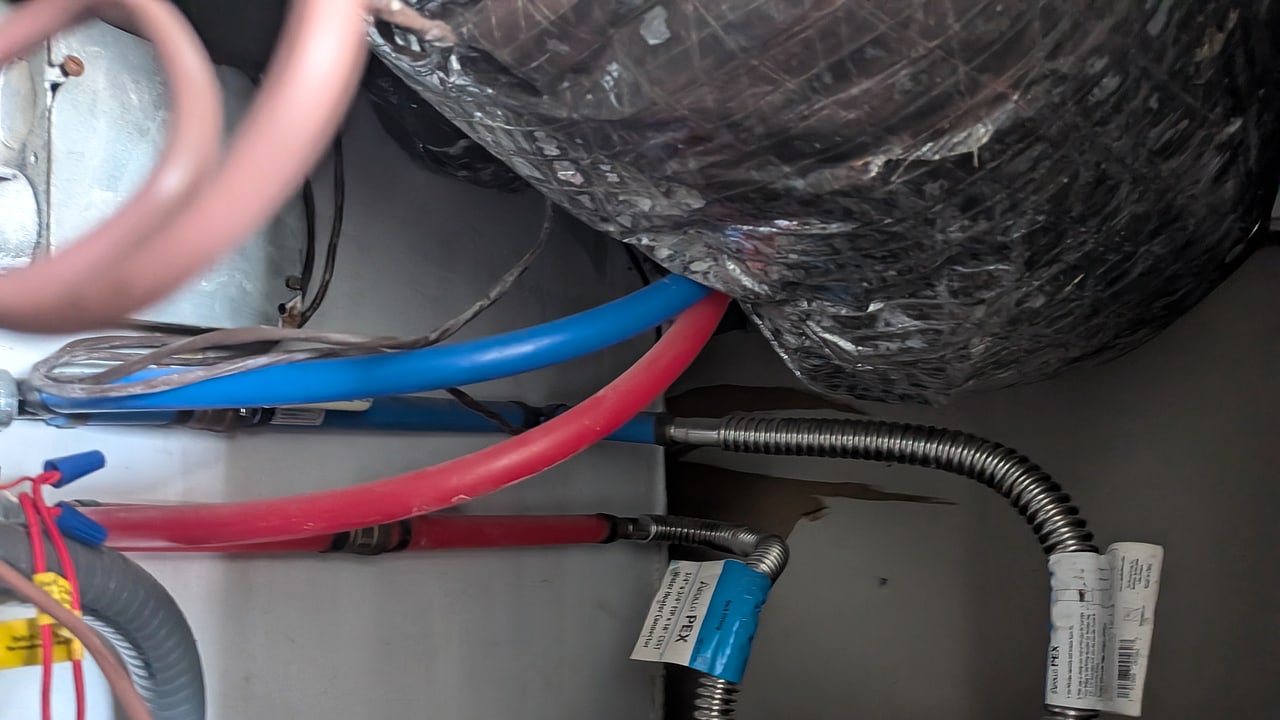
In residential real estate across Greater Houston, Katy, and Montgomery County, interior domestic water supply piping materials dictate long-term plumbing reliability. Homes constructed across different eras feature vastly different piping chemistries: rigid copper in mid-century homes, Chlorinated Polyvinyl Chloride (CPVC) in 1990s and 2000s subdivisions, and Cross-Linked Polyethylene (PEX) in modern builds. Knowing which material supplies your drinking water is essential to avoiding sudden catastrophic water damage.
1. The Problem with Aging CPVC: Chlorine Embrittlement
CPVC was heavily marketed to Texas production builders in the 1990s as a cheap, corrosion-proof alternative to copper. However, long-term exposure to chlorinated and chloraminated municipal drinking water, combined with extreme attic temperature swings (where Texas attics reach 140°F in summer), degrades the chemical polymer chain.
Over 15 to 25 years, the material undergoes severe embrittlement. Fittings, elbows, and glue joints lose all tensile elasticity. Even minor water hammer shocks or gentle contact by an attic service technician can cause instantaneous transverse pipe fractures, releasing hundreds of gallons of water per minute through second-floor ceilings.
2. Copper Piping: Pinhole Leaks in Aggressive Water
While Type L and Type M copper pipes provide decades of reliable service, properties supplied by private well water with low pH (<6.5) or high dissolved oxygen suffer from localized pitting corrosion. Pinhole leaks develop along horizontal runs beneath slabs or inside walls, weeping water undetected until baseboards rot and toxic mold colonies form behind drywall.
3. PEX-A vs. PEX-B: What Sets Them Apart
Modern construction overwhelmingly utilizes PEX tubing, but not all PEX is equal:
- PEX-A (Peroxide / Engel Method): Boasts the highest degree of cross-linking (>85%). It has superior thermal memory—if kinked during installation, it can be repaired with gentle heat-gun application. PEX-A utilizes cold-expansion fittings (Uponor ProPEX) that cannot blow apart under pressure. Most importantly, it expands during catastrophic winter freezes without bursting.
- PEX-B (Silane Method): Uses mechanical crimp rings or clamp rings with internal insert fittings. It is stiffer, less freeze-tolerant, and insert fittings reduce internal pipe diameter, slightly restricting water flow velocity.
4. Residential Building Science & TREC Standards of Practice
A certified residential home inspection is a rigorous evaluation of interconnected building systems. Under the Texas Real Estate Commission (TREC) Standards of Practice (§§535.227–535.233), Secured Inspections executes a systematic forensic protocol across all major home components:
- Structural Envelope & Elevation Survey: Auditing foundation slabs, crawlspace framing, exterior masonry weep screeds, roof trusses, and attic ventilation using digital altimeters and thermal imaging to detect active movement and moisture intrusion.
- Electrical Life-Safety Diagnostics: Verifying arc-fault circuit interrupter (AFCI) and ground-fault circuit interrupter (GFCI) trip response, main service grounding electrode bonding, panelboard temperature gradients, and branch wiring integrity.
- Mechanical HVAC & Indoor Air Quality: Testing sensible and latent cooling split differentials, condensate drainage safety float switches, combustion air supplies, gas furnace heat exchangers, and ductwork insulation R-values.
- Plumbing Supply & Drainage Pressure Testing: Checking static water pressure, thermal expansion tanks, water heater temperature-pressure relief (TPR) discharge lines, fixture flow, and waste drainage performance.
By delivering comprehensive, clear, and data-driven inspection reports, our forensic team ensures prospective Texas homeowners possess complete clarity regarding property condition before removing contractual contingencies.
Need an Objective Forensic Property Inspection?
Residential Pre-Purchase, ASTM E2018 Commercial PCAs, Termite WDI, Sewer Camera Scopes, and FLIR Thermal Infrared diagnostics across Greater Houston, Galveston, and Brazoria.
